A notebook-based method for thinking more clearly, for people who’ve tried every digital tool and still feel overwhelmed.
The core idea
Writing by hand forces slower, clearer thinking. Not because handwriting is magic, but because it’s slower than typing, slower than thinking, and slow is where clarity lives.
The goal isn’t to capture everything. The goal is to externalize the stuff that’s looping in your head, so your head can stop looping. Once something is on the page, you can forget it. The notebook remembers so you don’t have to. When the thing matters again, it’s right there where you left it. Offloading is different from organizing: you’re not building a system, you’re setting things down.
The setup
One notebook. Not one for work and another for personal. Not a project notebook and an ideas notebook. One. Deciding where something “belongs” is friction, and friction is why you stopped last time.
Kept where you actually are. Not aspirationally on the desk in the room you never use. On the couch where you sit. On the kitchen counter. Wherever you actually spend your time.
Each day gets its own page. Date at the top. Even if there’s only one line. Even if there’s empty space at the bottom. Dating pages turns the notebook into a record of your actual thinking instead of a scrapbook.
The seven practices
The method has seven practices. Two are distinctive to this method. Five are supporting techniques, some with roots in Bullet Journal and GTD, adapted here for a simpler context.
The Jumble Bullet
The most useful single technique in the method, and it’s the one you tried on the homepage. When you’re overwhelmed, take one line and write everything across it:
reply to Dan / the email you’ve been avoiding / that side project / call your mom / the thing you said in the meeting that came out wrong / dentist
— just slashes, no order, no hierarchy. Externalize the swirl. The act of writing it down is where the mental relief comes from. Not the organizing, not the prioritizing. The writing.
Idea Gardening
A way to capture half-formed ideas without committing to them. Mark them. Come back. Some grow, most don’t, and the ones that do grow better than the ones you tried to force. This is the opposite of the “capture everything” impulse that makes digital tools feel like obligations. You plant a seed and check on it later. No database, no tags, no backlinks.
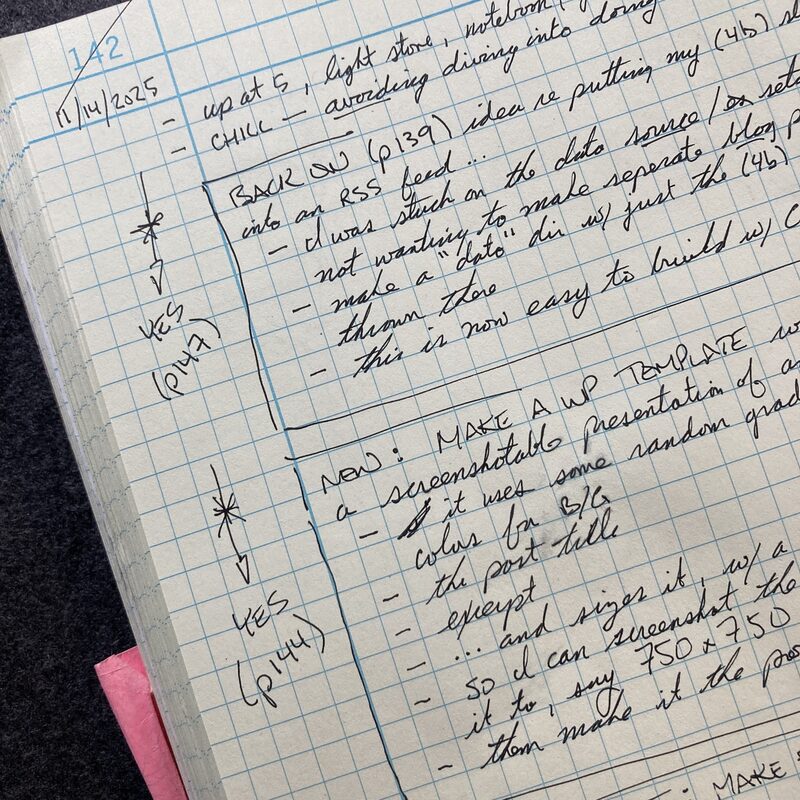
Table of Contents
The front of the notebook is a running index: page numbers and topics, added as you go. Makes the notebook findable without being a database. Four years from now, you open the notebook, flip to the front, and see exactly where everything is.
Flagging
Physical flags (sticky notes, tabs, paperclips) mark pages you need to come back to. The closed notebook still shows you where the live work is. Zero setup, zero maintenance.
Closing Loops
Arrows and marginalia for tracking unresolved questions and their eventual answers. Cross-references across pages, so nothing quietly disappears. If you’ve used GTD, you’ll recognize the instinct. This is the low-tech version: an arrow, a page number, done.
Bulleting
Short fragments instead of paragraphs. Faster to write, faster to scan. Not a style choice; a discipline that keeps your writing dense enough to reread.
Reflection
Periodically sitting with the notebook and reading backwards. Not journaling. Reading your own recent thinking to notice patterns, stuck points, and ideas that are ready to connect.
What you end up with
Do this for a year and you have a dated, indexed, flagged record of your actual thinking. Do it for five years and you have a shelf of notebooks you’ve actually used, not a graveyard of app exports. The filled notebook is itself evidence of what you’ve been working through. That accumulation turns out to matter.
What the book adds
The practices above are the complete method. The book (40 pages, about an hour to read) walks through all seven with real examples from my notebooks: worked pages, the specific moves that make each practice actually work, and what to do when you get stuck. It also covers which notebooks I actually use and why. Yes, any notebook works. Yes, I have opinions.
$19. Get the book on Gumroad →
Still wondering why any of this should work at all, given how good modern digital tools are? That question has its own page. Or skip the arguments and grab the one-page Quick Reference to try one practice today.